Showing posts with label homemade. Show all posts

Friday, August 15, 2014

Decanting

Decanted tinctures and one oil today!

Fresh dandelion leaf tincture : liver & digestive tonic
Fresh cleaver tincture : my fav remedy for swollen glands


Dried passionflower tincture: the BEST for anxiety, racing mind, headaches, & insomnia

Glowing fresh calendula flower oil : wonderful oil for the skin in salves, lotions, & just by itself

Monday, July 28, 2014

Tincture Making: Fool-Proof


Tincture making is seriously fool-proof medicine making. 
It is so easy to do...I mean, you can make it complicated...but I don't.
It's a great way to start making your own medicine at home if you never have before. Store bought tinctures are SO expensive, so if you do buy them you will be saving yourself a lot of money by making them instead. Making your own tincture is medicine in itself (every time you shake it think good thoughts!) because you are part of the process. 

And I'll add that tinctures are really handy to have...right before bed (instead of a cup of tea that will make you pee) and they are indispensable when traveling.

Now a lot of the time tinctures are used to preserve the fresh plant, but dried plants work well too (sometimes better for some herbs, in my opinion). So don't let that factor stop you--use what you have/can get!

And lastly, if you are avoiding alcohol you can make a glycerin-based tincture instead of an alcohol-based tincture. My personal preference is alcohol-based though.


The process:


   1. Put fresh or dried herb in a clean mason jar
   2. Add 100 proof vodka
3. Label jar with herb name & date
   4. Cap and store it out of the light in a cool dark place
   5. Shake daily, or as often as you can remember, for at least two weeks
   6. Uncap the jar
   7. Pour out the tincture into a bowl or something and squeeze out the wet herbs as best you can
   8. Filter the tincture through clean cheesecloth or something of that nature
9. Put back into clean mason jar and/or put into a small dropper/tincture bottle & label.

Congratulations! 
You just made medicine!


Passionflower in vodka.

Always label herb name, whether it is fresh or dried, date, and you can add alcohol type.

Passionflower tincture already turning colors after two days.

Thursday, July 24, 2014

Recently harvested herbs...

Calendula, Pot or Garden Marigold (Calendula officinalis)
Planted in our garden this year. I've been harvesting the flowers and drying them as well as making fresh calendula flower oil.
Chicory (Cichorium intybus)
Growing wild around our garden. Tincturing the flower and possibly harvesting some roots to roast?

St. John's Wort (Hypericum perforatum)
The little plant in our garden is started to flower.


Alfalfa (Medicago sativa)
The back pasture is covered in alfalfa.


Elder flowers (Sambucus)
Ecstatic to have access to elderberries this year.


Motherwort (Leonurus cardiaca)
Growing around the yard. I just made a fresh motherwort tincture two days ago.


Red Clover (Trifolium pratense)
Red Clover is everywhere sharing the fields with alfalfa right now.
Picking and drying, picking and drying, picking and drying...
Skullcap (Scutellaria baicalensis)
Once our skullcap plant is in full bloom we'll made a fresh tincture of it.


Queen Anne's Lace, Wild Carrot (Daucus carota)
Wild abundance everywhere. My old friend.


Salve.
My own salve, made with fresh herbal oils made early this spring.


Friday, February 3, 2012

Herbal Mouthwash

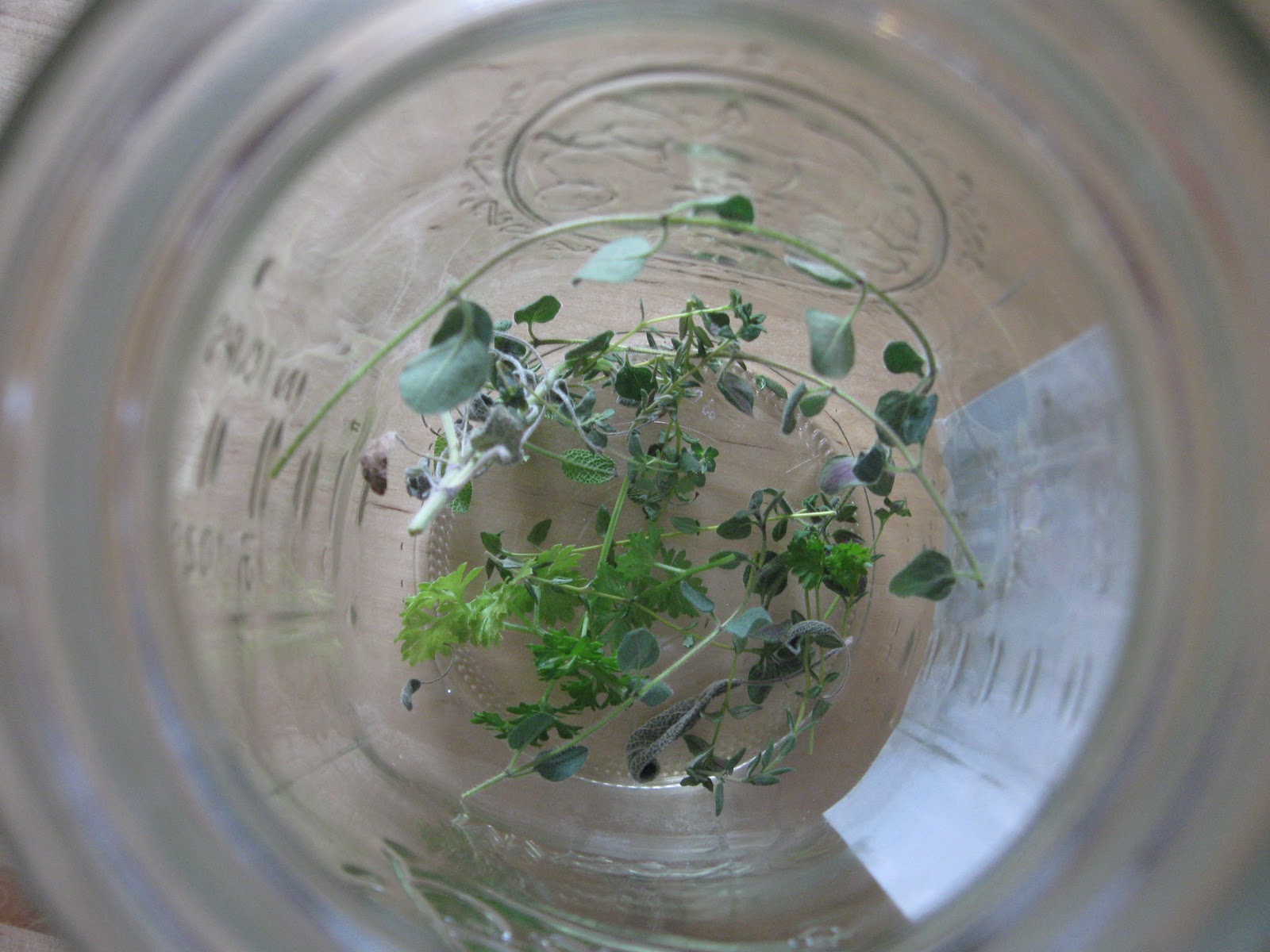
 Parsley, Sage, Marjoram, Thyme & Mint....


These herbs make an effective mouthwash just as a strong infusion. They are astringent, antiseptic and  have cleaning qualities that are great for oral hygiene.


Simply pour boiling water over fresh or dried herbs.Cover tightly with a lid & let sit for 24 hours to infuse.


Strain herbs and store infusion in a lidded jar or cup.
Swoosh around in mouth any time for a soothing, alcohol-free mouthwash.


Also, fresh sage leaf has been used for centuries to clean and freshen breathe.  Try it! Rub the leaf on your gums and teeth. Its antibacterial properties help clean and heal gum inflammation.

Sunday, January 29, 2012

Herbal Syrups


Sore throat syrup
4 cups water
2 tablespoons osha root
1 tablespoon echinacea root
1 tablespoon fennel seed
1 tablespoon slippery elm bark
1 teaspoon ginger root
Cook this down to two cups as directed above and then add:
One half cup honey
One quarter cup brandy
One quarter cup black cherry fruit concentrate
This is a great syrup to soothe the throat. It works best if you take one
tablespoon every two hours at the first tickle of a sore throat


Herbal-C Syrup
6 cups water
3 tablespoons elderberries
2 tablespoons pomegranate seeds or cranberries
2 tablespoons rose hips
1 tablespoon pine or cedar tree needles
1 tablespoon lemongrass
Cook this down to three cups and add:
One half cup molasses
One half cup honey
One half cup fruit concentrate
This is wonderful tasting syrup to take as a tonic during cold and flu season.


Wet and Damp Cough Syrup
4 cups water
2 tablespoons elecampane root
1 tablespoon thyme
1 tablespoon horehound leaf
1 tablespoon yerba santa leaf
Cook this down to two cups and add:
One half cup honey
One half cup brandy
This syrup is for lingering wet coughs with lots of stuck phlegm and mucus.


Elderberry Syrup
3 cups water
4 tablespoons of fresh or dried elderberries
one half cup honey
one quarter cup brandy
Put the elderberries and the water into a stainless steel sauce pan. Bring to a boil and then let simmer on low heat for fifteen minutes. Turn off the heat and let the elderberries infuse for a couple of hours. Strain the elderberries out and put them in the compost pile. You now have a strong elderberry tea. Turn the stove on low and simmer the tea without a lid on the pot until the tea is down to one half of its original volume. In this case you are starting with three cups of tea and cooking it down to one and a half cups. This process is called decocting. Take the tea off of the stove and add the honey while the tea is still warm. Stir in the honey until it is dissolved. After the tea cools, add the brandy. Store this syrup in the refrigerator with a shelf life of about three to six months. Take a tablespoon every hour and a half at the first signs of a cold or flu.


Monday, July 25, 2011

Homemade Deodorant

“If it can’t go in your mouth, don’t put it on your skin." -Rosemary Gladstar


Homemade Deodorant Recipe

Ingredients:
6-8 Tbsp Coconut oil (solid state)
1/4 cup baking soda
1/4 cup arrowroot powder

Directions:
Combine equal portions of baking soda & arrowroot powder.
Slowly add coconut oil and work it in with a spoon or hand blender until it maintains a firm but pliable texture. It should be about the same texture as commercial deodorant, solid but able to be applied easily. If it is too wet, add further arrowroot powder to thicken. Enjoy!


IMG_8218

Thursday, July 7, 2011

Herbal popsicles

The best way to enjoy herbs in the summer! Enjoy things like popsicles & ice cold drink only when it's really hot...cold liquids actually slow down your digestive system. Our bodies function better when drinks are room temperature.

The herb or herbs you choose are up to your preference. I really enjoy lemon balm in the summer for its relaxing, calming qualities
Proportions are up to how strong you want your popsicles to taste and how many popsicles you're going to make...

Boil herb or herbal blend in half water and half organic juice or lemonade for about 20 minutes.
Strain and pour into popsicle molds and freeze.

IMG_8225


IMG_8228


IMG_8237


Enjoy on a hot day!

Some good combinations...

Apple juice & Lemon Balm
Berry juice & Hibiscus flowers
Lemonade & Peppermint
Lemonade & Oatstraw
Pineapple juice & lemon verbena

All natural Hair Gel

Flax seed (Linum usitatissimum)

Internally flax seed is used in chronic constipation. It is indicated for the treatment of many chronic diseases, including arthritis, psoriasis and prevention of arteriosclerosis. It is used for cancer prevention, heart disease, and autoimmune disorders where inflammation occurs. It is high in omega-3 fatty acids.

It can be added to most any food, in the form of oil or seed, including baked goods, yogurt, smoothies/juices, and salads. Flax is a lovely demulcent. Taken as a tea it soothes irritated mucous membranes. Drink when you have a sore throat, IBS, lungs irritated from coughing, or kidneys and bladder irritated from passing stones. Flax tea is very moistening and very welcome in the winter when you are feeling cold & dry. It has a mild nutty flavor & tastes good with spicy, warming herbs like cinnamon.


IMG_8220


Externally flax has the same soothing, moistening properties. It can be made into an all natural hair gel that doesn't dry out and damage your hair the way commercial hair gel does. Plus, it is super easy and cheap to make.


Flax Hair Gel

1 tbs. flax seeds
1 cup water
aloe vera gel (optional)
essential oil (optional)
Small glass bottle with lid

Simmer flax seeds in water until the liquid is reduced by half.
Strain seeds.
Add a about a quarter as much aloe vera gel (for extra moisturizing) as you have flax gel.
Add a few drops of an essential oil of your choice (I like lavender) to help preserve the gel & smell nice.
Stir together & then bottle.


Because this is a natural product it will not last as long as commercial hair gels, which is why I make it in small batches & keep it refrigerated. I have had flax hair gel in the fridge for 6 months (then I had to make more) and it was still good. I use right after the shower and rub through my hair while it is still damp. Enjoy!


flax hair gel

Saturday, March 5, 2011

Sunday, January 2, 2011

Herbal Shampoo

Commercial shampoo is full of toxins that are bad for your body and the environment. These chemical toxins in shampoo are used to extend the shelf-life and to make products more cost-effective for the manufacturers. Some of these toxins are carcinogens (which means it directly causes or promotes cancer) and cytotoxins (a term used to refer to a substance that has a toxic effects on cells).
By making your own shampoo you can stop supporting companies that use chemicals, stop putting harmful and hazardous chemicals into our water and ground, and stop adding unnecessary toxins to your body.

Here is a simple recipe for herbal shampoo:

8 oz distilled water
1 oz herbs*
3 oz castile liquid soap
1/4 tsp jojoba oil
optional: 20 drops of pure essential oil

Bring water to boil.
Add herbs, cover, & let simmer over low heat for about 20 minutes.
Strain & cool.
Slowly add castile soap then add jojoba oil & essential oil.
Enjoy!


*calendula, nettle, and marshmallow are great for dry hair while rosemary and yarrow can be used for oily hair


homemade herbal shampoo for Zack

Saturday, April 10, 2010

Springtime Nettles

It's early spring! Start looking out for young Stinging Nettles....one of my favorite herbs and the first plant that made me curious enough to start an herbal apprenticeship. I have a strong connection with the nettle plant and feel obliged to say "Thanks!" every time I see it.
Nettles are among the most nutritious of wild foods. When they are cooked, the sting disappears, leaving behind an herb packed with more vitamins and minerals than you can imagine. Stinging Nettle is truly a super-food and very bountiful on the east coast of MA. Search for nettles in the early spring when they are still young and low to the ground. Make sure to bring gloves if you don't like being stung...it can be quite painful if you're not used to it! Cut the top 1/3 of the plant, give thanks to it by offering a pray, some hair, or tobacco, and put in your bag or basket. Bring it home to tincture, dry to tea, or make this soup:

Spring Nettle Soup
(adapted from a recipe from Susan Weed)
6-8 cups of nettle tops
6 cups water (or bone broth...even better)
1/2 chives, chopped
2-3 carrots, chopped
1-2 leeks, chopped
3 tablespoons miso
1-2 potatoes, cubed
salt & pepper
butter
1 cup yellow dock leaves (optional)
1/2 cup dandelion leaves (optional)
Directions: Wash vegetables and greens. Saute greens, leeks, and carrots in some butter for 5-10 minutes. Add bone broth or water and potatoes. Bring to a boil then simmer for at least a half hour. Add salt, pepper to taste and miso just before serving. Puree for rich green soup. Enjoy!

Westport Town Farm

Monday, October 26, 2009

Essential Oil Hand Sanitizer

Monday through Friday I'm inside a huge school filled with germy children who don't wash their hands enough and rely on alcohol & chemical based hand sanitizer as a cure-all. I do my best by eating nourishing foods (raw garlic!), using a neti pot, getting plenty of sleep, and making lots of preventative herbal decoctions and infusions. Sometimes though, I need another line of defense.
A couple days ago I threw together an essential oil hand sanitizer that doesn't contain all that weird stuff that commercial hand sanitizer contains and doesn't dry out my hands with alcohol. Because many viruses are airborne I also wanted something that I could dab under my nose to help keep the air I breath as virus-free as possible.

About the essential oils:
I chose Tea Tree because it's antibacterial, antibiotic, anti-infectious, fungicidal, antiseptic, antiviral, and MORE...a powerful essential oil! Lavender is a lovely smelling stimulant that is antimicrobial and antiseptic. Lemon Eucalyptus is antibiotic, anti-infectious, anti-inflammatory, antiseptic, antiviral, and bactericidal.


Essential Oil Hand Sanitizer

Store in a small spray bottle

1 tsp. aloe vera gel
3/4 cup witch hazel
15 drops lavender essential oil
10 drops tea tree essential oil
5 drops lemon eucalyptus essential oil

High Ledges

Tuesday, August 18, 2009

Tooth Care

The harmful chemicals, toxins, artificial colors and sweeteners in toothpaste are becoming more well known. Read labels carefully though...even products that claim they are natural have nasty ingredients.
The truth is making your own toothpaste, or tooth powder, is extremely easy, effective, and cheap.

homemade toothpaste

I combine baking soda (aluminum free), arrowroot powder, sea salt, and essentials oils to create my own tooth powder. Essentials oils such as peppermint, spearmint, lavender, myrrh, and cinnamon are anti-inflammatory, antimicrobial, and antiseptic (among many other things).
Keep tooth powder in a glass jar by the sink. A years supply with cost about three dollars!

making toothpaste